Our surroundings are filled with numerous organic compounds, such as plastics and pharmaceuticals, enriching society. Among organic compounds, those produced by plants, animals, and microorganisms are called natural organic compounds (natural products). Many natural products exhibit distinctive chemical structures and remarkable biological activity, attracting attention from diverse fields such as drug discovery, food science, and life science. Our laboratory is working on the artificial synthesis (total synthesis) of natural products that can be used as seeds for pharmaceuticals and pesticides, using readily available, simple molecules as starting materials. In parallel, we are also developing new reactions that will lead to more efficient synthesis of natural products and organic compounds with complex structures. If you are interested in "manufacturing" in the nano world, let's do research together.
Basic Information
Faculty name/Affiliation
Fumihiko Yoshimura / Department of Integrated Science and Engineering Environment and Biotechnology Course
Total synthesis research of bioactive natural products with unique structures, and development of synthetic reactions useful for the synthesis of complex organic compounds.
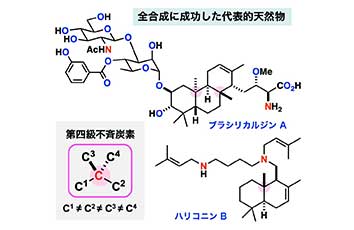
Total synthesis and functional elucidation of bioactive natural products containing quaternary chiral carbons.
Compounds rich in saturated bonds (sp3-rich compounds) adopt a three-dimensional structure, unlike highly planar compounds. These compounds are highly likely to interact specifically and strongly with target biomolecules, and are therefore being re-evaluated in recent pharmaceutical and agrochemical development research. However, the synthesis of sp3 carbon-rich compounds is more difficult than that of planar compounds due to challenges in constructing the carbon skeleton and controlling stereochemistry. We are conducting total synthesis research on bioactive natural products containing "quaternary chiral carbons," which are particularly difficult to synthesize among sp3 carbon-rich compounds, and which are composed of four non-equivalent hydrocarbon groups. In the future, we plan to utilize these synthetic compounds to elucidate the mechanism of activity at the molecular level.
Development of synthetic reactions utilizing previously unexplored chemical species
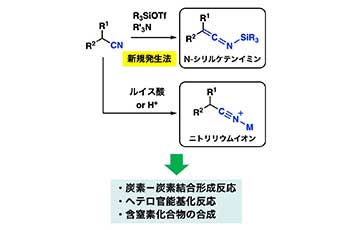
In developing synthetic reaction methods, the discovery of new reactive chemical species is beneficial because it brings about many ripple effects. We are developing reactions that streamline the synthesis of compounds with complex structures by utilizing highly reactive chemical species that have been overlooked due to difficulties in preparation and handling, despite their unique reactivity being expected from their structural characteristics. Specifically, we are focusing on N-silylketenimines and nitrilium ions, which can be prepared from ubiquitous alkanenitriles, with the aim of developing carbon-carbon bond formation reactions and heterofunctionalization reactions, which are the backbone of organic synthesis chemistry.