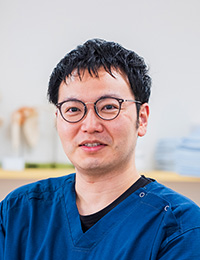
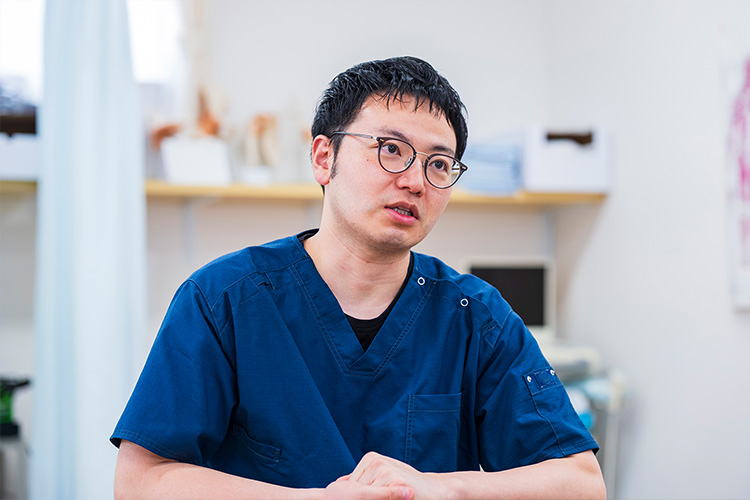
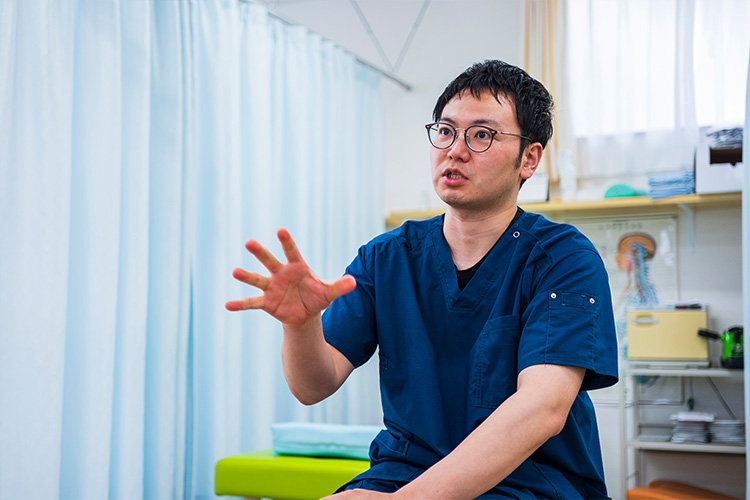
Assistant Professor Department of Judo Therapy Faculty of Medical Technology, Teikyo University Satoru Kumakura, Director of Teikyo Toyosatodai Judo Therapy Office
In 2013, he graduated from the Department of Department of Judo Therapy Faculty of Medical Technology Teikyo University. After obtaining a national license as judo therapist and Bachelor of Medical Technology, he worked as judo therapist at Teikyo Toyosatodai Judo Therapy Office, located on the university's Utsunomiya Campus. He then obtained Master of Judo Therapy in Judo Therapy from Graduate School Graduate School of Medical Care and Technology, Division of Judo Therapy. He is currently involved in education as Assistant Professor in Department of Judo Therapy, his alma mater, and also interacts with patients daily as the director of the orthopedic clinic.
To summarize this report ...
Judo has its origins in Jujutsu, an ancient Japanese martial art, and contains both "methods of survival" and "methods of death."
Killing techniques involve training to hone the skills, and techniques for healing injuries sustained during training have been refined.
Killing techniques became a sport, and active techniques were established as back surgery techniques for judo therapist and became part of medical care.
To become judo therapist one must receive training at a judo therapist training school and pass a national examination.
On the other hand, modern medicine has evolved dramatically, and knowledge of body tissues other than bones and muscles has deepened, so that judo therapist are now required to have advanced medical knowledge, and the difficulty of obtaining national qualifications is increasing every year.
In order to perform daily physical maintenance, it is important to understand the patient's lifestyle and physical structure, and then plan to find the optimal long-term muscle and bone condition and bring it closer to the ideal state.
This physical perception and the SDGs approach are similar
The SDGs are not about fixing one thing; they require a combination of overall and partial optimization to make the entire world sustainable.
The SDGs, which can be considered a way of revitalizing society, may have something to learn from the way of revitalizing society that gave birth to judo therapy.
The required "method of living"
Judo has its origins in Jujutsu, an ancient Japanese martial art. Jujutsu consists of "Katsuho" (life-saving technique) and "Katsuho" (killing technique). In Katsuho, you practice to hone your skills, but you cannot kill your training opponent. That said, you cannot hone your skills unless you practice seriously. Naturally, injuries increase. Therefore, Katsuho (life-saving technique) for healing injuries, or treatment methods (Judo Therapy), were also refined at the same time.
Judo's modern-day spread as a sport around the world is the result of peace making killing unnecessary and developing it into a competitive sport or as part of education in various countries around the world. Its diverse techniques and training methods make it highly popular around the world. Meanwhile, Katsuho (Katsuho) has been established as a treatment method for judo therapist and continues to evolve as part of medical care. In Japan, it has become a national qualification, and its scope of application is expanding, even as it serves as an aid to sports trainers. Since judo practitioners originally theorized what they healed intuitively, it is important to first understand how to use the body when performing judo. Whether it's throwing techniques or ground techniques, they are based on the movements possible with human muscles, joints, and bones. By analyzing these movements, we can understand the body's limitations and functions. At the same time, it is likely that modern medical advances played a major role in the systematization of judo into the modern system.
How to become judo therapist
To become judo therapist, students must complete a training course at a judo therapist training school and pass a national examination. The difficulty of obtaining national certification increases every year. Because important body tissues, such as muscles, nerves, blood vessels, and organs, are concentrated around bones, there is an increasing need to acquire some of the knowledge required for Surgery and Internal Medicine. At university, students will learn the contents of Surgery and Internal Medicine, as well as basic knowledge of X-rays and medical procedures. Judo is also a required component of the course. While judo is a technique derived from jujutsu, the basic goal is to deepen knowledge of judo therapy by understanding the skeletal structure and mastering the movements used to apply techniques. By acquiring this extensive knowledge, students will be able to obtain a license as judo therapist. While judo therapy is generally thought of as a place for bone setting, it also treats fractures, dislocations, bruises, sprains, and other injuries known as pulled muscles, helping to promote recovery. The knowledge that modern judo therapist have is based on general medical care, so it may be difficult to understand the profession of judo therapist simply by using the term "osteopathy."
Of course, we cannot treat open fractures, muscle tears, nerve damage, or Surgery requiring surgery. For example, some injuries are not visible to the naked eye and involve the subcutaneous tissue, requiring a Surgery approach. In such cases, the patient first comes in for a consultation. If a Surgery decision is deemed necessary, they are referred to a medical institution for X-rays and a diagnosis by a doctor. If Surgery treatments for bone realignment or muscle damage are possible, the patient visits us, where a treatment plan is developed under the doctor's guidance. If Surgery is necessary, the doctor will develop a treatment plan. If Surgery approach is completed and the patient moves on to the motor function recovery phase and there are no problems, we may shift to our treatment. While a variety of patients visit our clinic, there are cases where complete recovery is not achieved without medical advice. Therefore, as judo therapist, it is important for us to understand the scope of Surgery and Internal Medicine in order to determine whether medical advice is necessary.
Planning that “examines people”
Treatment plans by judo therapist are relatively long-term. Motor dysfunction related to bones and muscles is more likely with age. While some are due to aging, many are unrelated to age and stem from old injuries, posture, and lifestyle habits. As a result, symptoms tend to recur, requiring long-term, patient treatment. Incidentally, although not generally recognized, judo therapist can also treat the jaw. Because the jaw is part of the skeleton, treatment is possible if it's dislocated or painful. Needless to say, however, dental treatment is not available. In addition, if a small child hits their head on the floor and is crying, they can come to our chiropractor and receive treatment if it's a bruise. If a doctor's diagnosis or X-ray is deemed necessary, we can immediately refer them to a doctor. We constantly assess various symptoms and devise treatment plans accordingly.
It's important to understand the patient's condition from various perspectives. For example, the way a patient walks when entering the clinic, their walking posture, and even their sitting movements can sometimes cause discomfort. Based on this, we then interview the patient to determine the location of the pain or ailment. At this stage, we determine the treatment plan, but palpation is crucial. Patients' reactions to touch, such as pain or discomfort, provide important clues, and we often use these to plan treatment. Treating many cases not only deepens our knowledge of the human body, but also allows us to understand how lifestyle, skeletal structure, and even everyday habits affect the body, and what treatments can correct the condition. Even if the patient says they're fine, their body and brain may compensate for the pain or discomfort, so we often feel it's best to actually restore their normal state. Because we focus on the skeletal structure itself, patients may feel pain when touched in areas other than the affected area, even if they have no subjective symptoms. It may be better to think of us as an osteopathic clinic that discovers potential sources of injury or pain, makes suggestions, and works hand in hand with patients to improve their condition, as this will make it easier to respond to sudden injuries.
Will the SDGs be achieved?
The perspective of the SDGs is too big for us, but in the sense that our treatments are based on quality of life, we are facing this issue, and we believe that human health is always of global importance. In particular, the way we think about bones and the human body is similar to the process of considering the goals of the SDGs. For example, when trying to repair one bone, muscles, nerves, other bones, etc. are connected, so we must consider the whole and optimize each part. I think that the SDGs are probably similar in that we cannot repair just one part, but rather we need to look at the whole and improve each part in its optimum form.
"Katsuho" could be an important concept in a variety of fields. Thinking of it as a way to bring life to life may make it easier to understand in modern times. In fact, even when we provide treatment, those who improve tend to have a strong sense of well-being, and their lifestyles tend to improve based on our advice. Our work primarily focuses on enhancing people's natural healing abilities and guiding them in a positive direction through advice. However, human life and social conveniences change constantly. I feel that in order to continue providing treatment, awareness and understanding from not only ourselves but also our patients is essential. The same is true for the SDGs. Human activities are constantly changing, and I believe that determining what is good for people and improving them is also what the SDGs require. While we focus on the quality of life of our patients, the SDGs are a current action plan for improving the future. In that sense, it is up to us to make the most of the SDGs. To achieve the SDGs for the health of society, our own awareness and actions are of utmost importance. Like the Katsuho in judo, I feel that in order to create a "Katsuho" that will actively improve the SDGs, it is most important for many people to understand themselves and society, pool their wisdom on how to fix what has deteriorated, and systematize it as they put it into practice.