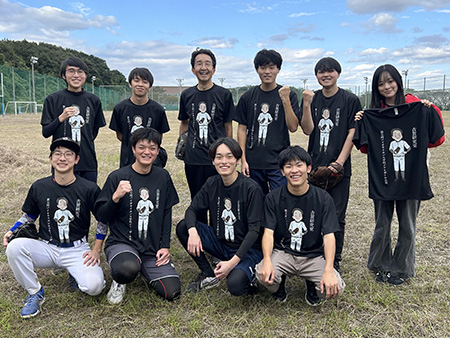
Biomolecular Chemistry Laboratory (Niichiro Koga Laboratory)
Our laboratory is researching the roles of cocoa protein (protein derived from cocoa beans), which has the effect of improving bowel movements and is found in large quantities in high-cocoa chocolate, and sphingolipids (such as glucosylceramide and ceramide), which have various functions such as cancer suppression in animals, improving skin moisturizing, and disease resistance in plants. I am in charge of lectures and experiments on basic microbiology for first-year students, applied microbiology for second-year students, food science experiments for second- and third-year students, and microbial utilization for Graduate School. By focusing on industrial applications, I provide lectures that make it easy to imagine how the content students are learning can be used in industry.
Basic Information
Faculty name/Affiliation
Jinichiro Koga / Department of Integrated Science and Engineering Environment and Biotechnology Course
Cacao protein that has a bowel movement improving effect Research on sphingolipids that suppress cancer in animals and induce disease resistance in plants
Joint research with a company on the “health effects of consuming high-cocoa chocolate”
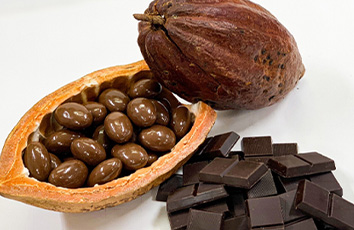
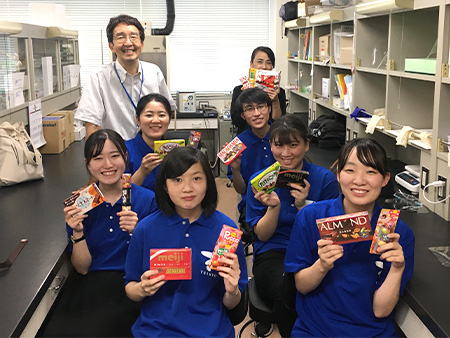
High-cocoa chocolate is labeled as CACAO72, CACAO86, or Cacao70, and chocolate that contains a large amount of cacao beans, the raw material for chocolate, is called high-cocoa chocolate. Through joint research with Meiji Co., Ltd., our laboratory was the first in the world to discover that the cacao protein (protein contained in cacao beans) contained in high cacao chocolate regulates the intestinal environment and improves bowel movements. Did. Additionally, consuming high-cocoa chocolate increases the number of intestinal bacteria that produce butyrate (a short-chain fatty acid), which is expected to suppress colon cancer, prevent inflammatory bowel disease (IBD), and prevent diabetes. Found in the human intestine. This discovery was featured in numerous media outlets, including NHK General TV's "Asaichi," Mainichi Shimbun, and Asahi Shimbun. As a result, high-cocoa chocolate became a big hit, and even today, candy stores are filled with high-cocoa chocolate products.
“Elucidation of the physiological effects of plant ceramides and their effective use as sustainable materials”
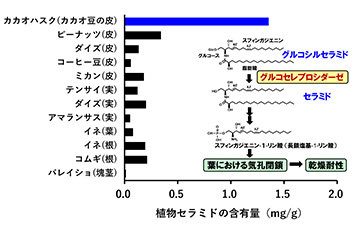
Plant ceramides consist of two types, glucosylceramides and ceramides, and are known to have skin moisturizing effects and colon cancer prevention effects when ingested. In our laboratory, we have established a new method for analyzing and quantifying plant ceramides using liquid chromatography electrospray ionization tandem mass spectrometry (LC-ESI-MS/MS), which has been considered difficult until now. For the first time in the world, researchers discovered that the enzyme glucocerebrosidase, which converts glucosylceramide to ceramide, is widely present in seed plants and is involved in drought tolerance in plants. In joint research with Meiji Co., Ltd., by using this latest LC-ESI-MS/MS analysis technology, we are using the unused part of cacao beans, the raw material of chocolate, to extract the cocoa husk (seed coat) from other plants. found that it contains far more plant ceramides. Therefore, cacao ceramide can be expected to significantly reduce the cost of extraction and manufacturing, and is expected to be used in a variety of foods and cosmetics as a sustainable material.
Papers and Conferences Presentation
Paper presentation
Title
Journal title
Laboratory
Contents
A new drought tolerance mechanism in plants mediated by glucocerebrosidase
Dietary fungal glucosylceramide and ceramide reduce the formation of aberrant crypt foci in 1,2-dimethylhydrazine-treated mice: Differences in the role of glucosylceramide and ceramide.
Purification and characterization of a new family 45 endoglucanase STCE1 from Staphylotrichum coccosporum, and its overproduction in Humicola insolens.
Functions of glucosylceramide in plants and fungi ~ A new drought tolerance mechanism in plants mediated by glucocerebrosidase ~
Joint symposium of the Japanese Society of Agricultural Chemistry and the Hokkaido Branch of the Japanese Society of Nutrition and Food Science (Tokachi Plaza, August 5, 2023)