To further pursue sports medicine and science, We will strengthen support for athletes.
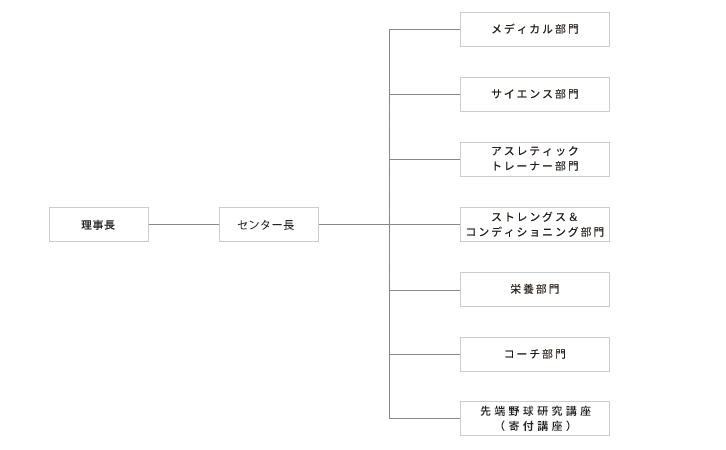
We have established six departments: "Medical," which promotes the treatment and research of sports injuries and diseases affecting athletes; "Athletic Trainer (AT)" and "Strength & Conditioning (S&C)," which work with athletes on the field to implement initiatives for return to competition and performance improvement; "Science," which conducts measurements and research in accordance with biomechanics and exercise physiology; "Nutrition," which provides nutritional management to prevent injuries and illnesses according to the characteristics of the sport, condition, and physical development goals; and "Coach," which realizes athlete support by utilizing specialized knowledge. Our aim is to contribute to the development of the sports world by realizing a total support service through the collaboration of these six departments.
Based on the belief that the evolution of the sports field is essential for the prevention and treatment of sports-related injuries, and ultimately for improving athletes' performance, each department—Medical, Science, Athletic Trainer (AT), Strength & Conditioning (S&C), Nutrition, and Coaching—is actively working.
In addition to strongly supporting athletes as a daily activity, we aim to contribute to the development of sports medicine science by encouraging research activities in order to support all athletes, not limited to our university.
We provide sports medical support to athletes belonging to Teikyo University Group athletic clubs, primarily Teikyo University's Intensive Training Club, as well as top athletes from outside the university, contributing to the prevention and treatment of sports injuries and the improvement of performance.
We will contribute to the development of sports medicine science by disclosing the above activities and research results internally and externally through academic society activities and submission of academic papers.
This center was established in 2011 to further develop Department of Sport and Medical Science that was established earlier, and to strengthen sports science research and support for athletes.
Aiming for sports medicine scientific support inside and outside the university
In March 2008, former President Shoichi Okinaga announced his vision of providing sports medical and sports scientific support, primarily to Rugby Football Club and Ekiden (Road Relay) Club, to help prevent and treat sports injuries and improve performance. Furthermore, in the future, these activities will be expanded both on and off campus, and an organization will be established that will contribute to society as Teikyo University. This led to discussions about establishing a Sports Medical Science Center.
Based on this concept, Masato Takao (then Professor Department of Sport and Medical Science) and Masayuki Iwade (then Associate Professor of Department of Sport and Medical Science and Rugby Football Club Coach) took the lead in coordinating with doctors, athletic trainers, nutritionists, and researchers to start regular medical checkups for all members of designated sports clubs, a sports outpatient clinic at Hachioji Campus Clinic, emergency response in the event of a sports injury, and athletic rehabilitation for returning to competition after a sports injury. As these activities produced solid results, the Center was established on April 1, 2011, at the direction of President Yoshihito Okinaga, with the aim of providing sports medical support to athletes and advancing sports medical science.
When the center was first established, it began supporting three on-campus athletic clubs Rugby Football Club, Ekiden (Road Relay) Club, and Cheerleading Club, but in 2013 the baseball club joined in. With the opening of the Teikyo University Institute of Sports Science & Medicine building in October 2018, the center has gradually expanded its services to sports athletes outside the university.
Organization / system diagram
Member
Head of Center Professor Takumi Nakagawa
Deputy Head of Center Professor Masayuki Iwade
executive committee Professor Wataru Miyamoto Associate Professor Jun Sasahara
Associate Professor Sasahara (Head of Medical Department) Professor Atsushi Fukai Professor Naoyuki Yokoyama Professor Yoichi Yasui Associate Professor Aomi Toyooka Senior Assistant Professor Hiroshige Iseki Keisuke Tsukada Senior Assistant Professor Assistant Professor Shigeki Negami Yusuke Hirahata Researcher Teaching Associate Shuichi Umeki
Senior Assistant Professor Norio Saga (Head of the Science Department) Professor Shinji Sato Senior Assistant Professor Tomo Onishi
Takumi Matsuda, Senior Assistant Professor (Head of Athletic Trainer Department) Senior Assistant Professor Yasuaki Okawa Assistant Professor Ozo Takesue Assistant Professor Kenichiro Tsuru Assistant Professor Yuki Matsunaga Assistant Professor Reika Otsuka Assistant Professor Shunsuke Shiraki Akiko Muto, Trainer Natsumi Otake, Trainer Keisuke Fujita, Trainer
Senior Assistant Professor Kei Kato (Head of Strength & Conditioning Department) Assistant Professor Seiichiro Takei Trainer Katsutoshi Sato Trainer Masataka Yoshikai
Senior Assistant Professor Mizue Fujii (Head of Nutrition Department) Senior Assistant Professor Maya Toraishi Mayumi Kasai, Senior Assistant Professor Assistant Professor Mamiko Ichikawa Maki Shibasaki, Registered Dietitian Yuka Okano, Registered Dietitian Yuki Okumura, Registered Dietitian Yuki Tanabe, Registered Dietitian Mizuho Miyatani, Registered Dietitian
Tomokazu Soma, Senior Assistant Professor (Head of Coaching Department, Rugby Football Club Head Coach) Takayuki Nakano, Associate Professor (Head Coach Ekiden (Road Relay) Club) Kana Iwano, Senior Assistant Professor (Cheerleading Club Coach)
Atsushi Masujima, Specially Appointed Professor Yuya Masuda, Specially Appointed Professor Jun Sasahara, Specially Appointed Associate Professor Jun Kanda, Specially Appointed Associate Professor Yuto Yamada, Project Assistant Professor Yusuke Hirahata Researcher Mizue Fujii, Specially Appointed Senior Assistant Professor Yasuaki Okawa, Specially Appointed Senior Assistant Professor
(As of May 2026)
Introduction of research and activities
In addition to the knowledge in the field of sports medicine accumulated in a wide range of sports fields, we are working to improve the prevention and treatment of sports injuries by collecting information from field athletes on a daily basis and conducting research activities.
Main research and activities
screening We conduct the following medical checks to prevent sports injuries. (1) Questionnaire for players (2) Medical examination by a doctor (3) Physiological function tests such as electrocardiogram, respiratory function test, and ultrasound. (4) X-ray examination of the chest and limbs (5) Morphological measurements such as alignment (6) Physical checks such as tightness, range of motion, and muscle strength. Furthermore, for athletes deemed to require further detailed examination, we instruct them to undergo MRI scans or consult with specialists, and provide individual support based on the results.
Awareness campaign for athletes We provide lectures to athletes to help them gain knowledge about injuries specific to the characteristics of their respective sports.
Regular blood tests, body composition measurements, and nutritional surveys Blood tests, body composition measurements (InBody720), and nutritional surveys are conducted once a month to understand nutritional status, anemia, fatigue level, etc. If any abnormalities are found in the athletes, they are interviewed individually by a registered dietitian and receive nutritional guidance, and if necessary, undergo Internal Medicine checkups and treatment.
Training guidance for sports injury prevention and performance improvement.
Athletic trainers (AT) and strength and conditioning (S&C) trainers provide training at our center and on the ground.
Diagnosis of athletes at our center's Sports Medicine Clinic Teikyo University Clinic for Sports Science & Medicine is a clinic specializing in sports medicine, located within Teikyo University Institute of Sports Science & Medicine. It is equipped with a variety of treatment options, including ultrasound, plain X-ray, and MRI imaging equipment, as well as extracorporeal shock wave therapy and hyperbaric oxygen therapy. Except for extracorporeal shock wave therapy and hyperbaric oxygen therapy, all treatments at this clinic are covered by health insurance.
Medical support for top off-campus athletes We also provide medical support to top athletes outside the university, including soccer, baseball, and volleyball.
athletic rehabilitation Postoperative and conservative treatment in the event of injury or surgery is performed by athletic trainers under the direction of a doctor within our center. We also offer acupuncture treatments at our center.
Support at competitions and training camps Sports doctors accompany the tournament and training camp as needed to provide medical support.
Training in Japan and overseas Aiming to make this center equal to or higher than similar facilities in each country, we dispatch our staff to major facilities in Japan and overseas for training.
The effectiveness and safety of hyperbaric oxygen therapy for ankle sprains
The effectiveness of ultrasound-guided PRP therapy for hamstring muscle strains.
Risk factors for re-injury and secondary injury of hamstring muscle strain
The effectiveness of hydrorelease on the soleus branch of the tibial nerve in lower limb sports injuries.
The effectiveness of hydrorelease on lumbar nerve roots in lower limb sports injuries.
Effectiveness of diffuse pressure wave therapy for lower limb muscle injuries
Could changes in finger pinch strength become a new indicator for preventing pitching injuries, replacing the number of pitches thrown?
The relationship between sleep evaluation of professional baseball players and their athletic performance and mental health.
A multicenter collaborative study on high-speed athletic performance and return-to-sport performance after lower limb muscle and ligament injuries.
Could AI-powered physical activity navigation improve the well-being of isolated older adults?
Evaluation of eccentric muscle strength characteristics for the purpose of preventing hamstring muscle strains.
Examination of strategies for early recovery from muscle injury and delayed-onset muscle soreness following eccentric contraction.
Relationship between energy expenditure and Relative Energy Deficiency in Sport (REDs) related indicators in female university cheerleaders.
Examination of the characteristics of total energy consumption under free living conditions of male professional baseball players using the double-labeled water method.
About body water turnover in athletes
Clarification of power characteristics by sport and position, and establishment of power standard values.
The importance of release in baseball pitching.
The relationship between hamstring eccentric muscle strength and injury/disability incidence in female university judo athletes.
The relationship between mindfulness traits and injury acceptance in college athletes
Examination of concussion prevention measures in competitive cheerleading
Development of purpose-specific and stage-specific training packages for high-intensity interval training.
Relationship between the physical condition of university rugby players and the occurrence of injuries and disabilities.
Access
The center is located on Hachioji Campus where each club is active.
Teikyo University Institute of Sports Science & Medicine 359 Otsuka, Hachioji-shi, Tokyo 192-0395 Hachioji Campus Sports Medical Science Center Building