
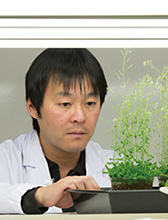
Plant Physiology Laboratory (Masashi Asahina Laboratory)

Masashi Asahina

Our laboratory is conducting research on the response of plants to environmental changes such as cutting injuries and light and temperature, focusing on the functions of plant hormones and genes. Restoration of plant wounds (tissue fusion) is a mechanism of injury response essential for survival in nature and is a very important phenomenon used as a graft in agriculture. In order to clarify this mechanism, we are conducting research using various methods such as molecular genetic methods such as gene expression analysis, grafting experiments on fruits and vegetables, and observation of microstructure using a microscope.

Basic Information

Faculty name/Affiliation Masashi Asahina / Department of Integrated Science and Engineering Environment and Biotechnology Course
Specialized Fields Plant physiology, plant molecular biology
Research theme Elucidation of fusion and environmental response mechanism of severed plant tissue
Research keywords Plant physiology, plant hormones, grafting, tissue fusion, genes, environmental response
Faculty introduction URL https://www3.med.teikyo-u.ac.jp/profile/ja.aecb88c4e47c5a44.html

Our Research

Healing mechanism of plant cutting tissue

Healing mechanism of plant cutting tissue

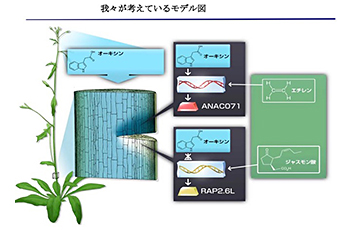
The stem of the plant supports the plant body, sends water and minerals absorbed by the roots to the leaves and buds above the ground, and works as an important communication route to send the assimilated products synthesized by the leaves to the roots. When the stem is physically injured by wind or eaten by insects, the lost tissue is regenerated and the tissue is healed by healing in order to heal the wound. .. We identified transcription factors essential for the fusion of cut flower stems of the model plant Arabidopsis thaliana and found that they are regulated by phytohormones. Currently, we are elucidating the mechanism by which plant hormones such as auxin and jasmonic acid regulate the gene expression of transcriptional regulators, and these transcriptional regulators act as control towers to fuse tissues through the expression of genes related to cell division and cell walls. We are working to elucidate the mechanism that achieves this.

Molecular mechanism of plant hormones involved in graft adhesion

Molecular mechanism of plant hormones involved in graft adhesion

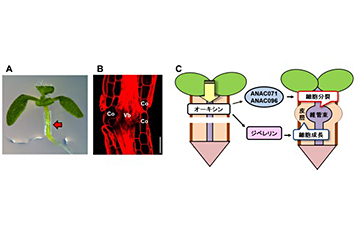
Grafting is performed by filling the space between the scion and the rootstock with newly divided cells, and it is known that this cell division requires the plant hormone auxin. In our research group, two NAC-type (NAM, ATAF and CUC) transcription factors induced by auxin work redundantly using Arabidopsis seedlings to induce cell division of vascular tissue in the hypocotyl indirect graft. Clarified to promote. It has also been shown that auxin is involved in cell growth in the cortical layer by promoting the synthesis of gibberellin. The results of this research will not only lead to the elucidation of the basic molecular mechanism of plant injury recovery and tissue regeneration, but are also expected to be applied to new agricultural technologies.

Elucidation of the functions of plant hormones involved in plant environmental response and organ differentiation

Elucidation of the functions of plant hormones involved in plant environmental response and organ differentiation

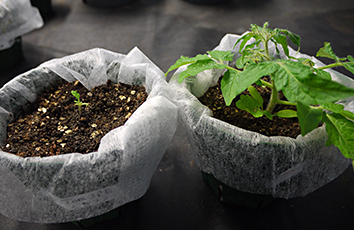
Research is conducted for the purpose of involving plant hormones in the adhesion of grafts such as tomatoes, male-female differentiation of male and female alien flower plants (such as spinach), and elucidating the functions of plant hormones involved in the formation of antheridium and egg-forming organs of fern plants. I am. We are also working to establish an analysis method from trace tissues using the laser microdissection method for the purpose of spatiotemporal analysis of plant hormone biosynthesis and gene expression in response to environmental changes.