Reproductive Developmental Biology Laboratory (Ryoma Ota Laboratory)

Ryoma Ohta

We, sexually reproducing animals, including humans, have been able to connect life with continuous cotton by producing germ cells (eggs and sperms) and fertilizing them. How can we make germ cells that are responsible for this continuity of life? For the purpose of clarifying, we are mainly conducting research using Drosophila melanogaster. Our laboratory mainly conducts basic research, but the results will be the basis of technology for artificially controlling germ cells, and will be applied to assisted reproductive technology and efficient species of useful organisms in the fields of fisheries and livestock. It also leads to production.

Basic Information

Faculty name/Affiliation Ryoma Ota / Department of Integrated Science and Engineering Environment and Biotechnology Course
Specialized Fields Reproductive biology / developmental genetics
Research theme Elucidation of germ cell formation mechanism
Research keywords Germline, sex determination, quality control, Drosophila melanogaster
Faculty introduction URL https://www3.med.teikyo-u.ac.jp/profile/ja.d0afed3411e33478.html

Our Research

Elucidation of sex-determining mechanism in germ cell formation process

Elucidation of sex-determining mechanism in germ cell formation process

The primordial germ cells, which are the basis of germ cells, are formed in the early stages of embryogenesis, and then their sex is determined and they differentiate into eggs and sperms. However, the molecular mechanism of sex-determining mechanisms in primordial germ cells has not been fully elucidated. We use comprehensive gene expression analysis in male and female primordial germ cells, genetic analysis by RNA interference method, and primordial germ cell transplantation technology to create gender differences in germ cells. I am working on the elucidation of.

Elucidation of quality control mechanism in germ cell formation process

Elucidation of quality control mechanism in germ cell formation process

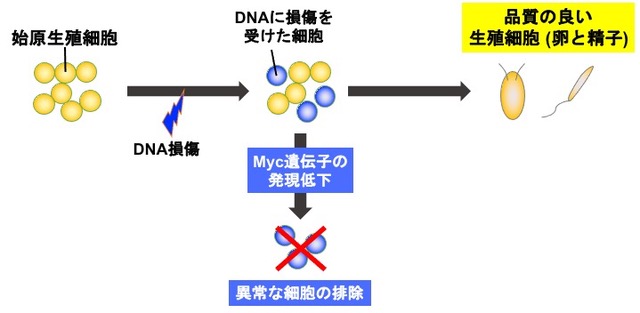
Germ cells are the only cells that will be passed down to the next generation. Therefore, if abnormal germ cells with damaged DNA are created, it will not be possible to produce a normal next generation. In order to prevent this, it has been thought that there is a mechanism (quality control mechanism) that eliminates abnormal cells and selects high-quality germ cells in the process of making germ cells. We have previously shown that reduced expression of a gene called Myc is involved in the elimination of abnormal germ cells. In the future, we would like to elucidate the quality control mechanism of germ cells by clarifying the mechanism from DNA damage to the decrease in Myc expression and the mechanism of cell exclusion induced by the decrease in Myc expression.