Aircraft have rapidly evolved in terms of range, top speed, and economy since the latter half of the 20th century by incorporating the latest technologies in aerodynamics, materials technology, engine technology, electrical and electronic technology, systems engineering, and reliability engineering. Our laboratory conducts research on aerodynamic devices utilizing fundamental fluid dynamics knowledge, and research on improving the performance and characteristics of aircraft using aerodynamic devices. In addition, we are conducting research and development on experimental and measurement techniques for wind tunnel testing necessary for the development of aerodynamic devices, research on numerical analysis methods used for numerical analysis of flow fields, and research on airfoil characteristics in the low Reynolds number region, in particular research on constructing fluid circuits in the flow field around airfoils.
Basic Information
Faculty name/Affiliation
Yasuhiro Koshioka/ Department of Information Science Correspondence Course
Specialized Fields
Fluid dynamics, aircraft engineering
Research theme
Development of aerodynamic devices utilizing fluid phenomena and improvement of aircraft performance and characteristics through their application.
Research keywords
Flow stability, low Reynolds number airfoil, aircraft design
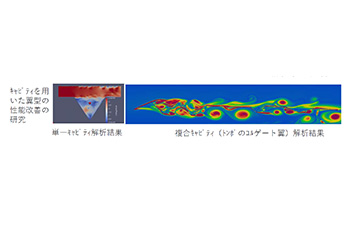
Construction of fluid circuits using cavities Maintaining the boundary layer on the wing surface in an appropriate state (laminar or turbulent flow) can improve the performance and characteristics of the airfoil. It is known that the corrugated wings of dragonflies have multiple cavities, and that the flow on the wing surface is controlled by vortices within these cavities. By combining the vortex disturbances created by the cavities with the shear flow field placed on the wing surface, it is possible to improve the stall characteristics of the airfoil by combining the oscillation of disturbances with the amplification effect of shear flow.
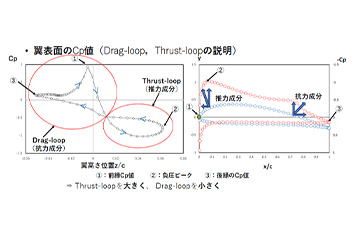
Research on improving the lift-drag characteristics of low Reynolds number airfoils. In designing low-Reynolds number airfoils with excellent lift-drag characteristics, the basic principles are to ensure that the pressure distribution in the forward section of the airfoil has a large thrust component, and to ensure a reliable transition of the boundary layer in the rear section to suppress the increase in pressure drag in the rear section. It is necessary to pursue an airfoil shape that can reconcile these two design guidelines, and improvements in lift-drag characteristics are being made by investigating the relationship between these characteristics and the characteristic quantities of the airfoil shape (camber and suppression distribution).