



Teikyo University Kendo Club Coach
Professor Tetsuya Ozawa

He holds a seventh-degree black belt in kendo. During his high school years, he represented Kanagawa Prefecture and won the National Athletic Meet. He served as captain at Teikyo University. After playing for the corporate Kendo Club (Fuji Xerox), he was invited to coach the university's Kendo Club, and has been the manager since 2013. He is currently a staff member at the university.




Kendo is said to have started in the Heian period, around the same time as the Japanese sword. It passed through the Sengoku period and other periods, and in the peaceful Edo period, it became a sword for the sake of survival, and it began to place emphasis on the way of life and other aspects of the mind. For this reason, ranks are assessed not only on strength, but also on form, behavior, and etiquette.



There are 1st to 8th dan, as well as Hanshi, Kyoshi, and Renshi, and in addition to trial skills, behavior is also evaluated. To be eligible to take the promotion exam, one must practice for the same number of years as the dan, and once one has attained 2nd dan, two years must pass before one is eligible to take the 3rd dan exam. For this reason, one must devote all of their energy to etiquette and awareness in daily life, physical training, and studying.
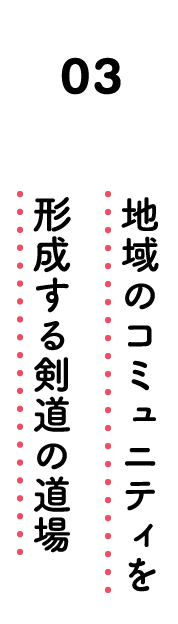


Kendo dojos, where people of all ages gather, function as a part of the local community. When students from Teikyo University's Kendo Club return to their hometowns for summer vacation, they sometimes drop by the local dojo to teach children. Rankings are based on etiquette as well as technique, which also contributes to building a stable community environment.


The Teikyo University Kendo Club has members who are close to professional athletes, but they also accept people with less experience in kendo, and are trying to maintain the culture of club activities as a dojo community. They also run trial classes for international students and carry out international projects such as providing kendo equipment to Ghana.


Kendo has martial arts elements, including self-defense, and technical elements, as well as a social element of fostering a community culture, which allows it to contribute to the stability of local communities. The health of local communities is an important theme in all countries. If we explore ways to popularize kendo from the perspective that the structure of kendo is valuable to the community, it could lead to an increase in the number of people involved in kendo and the solution of global issues.
