Teikyo Asia Graduate Program for Advanced Human Resource Development
This is a special program for international students. It aims to cultivate highly skilled individuals who will contribute to Asia's economic development by accepting promising students from rapidly developing Asia and providing education and research guidance based on the university's Practical learning philosophy. It also aims to foster individuals who will deepen their understanding of Japan by studying alongside Japanese students, laying the foundation for strengthening relations between Japan and Asia. This program is a selected program under the Ministry of Education, Culture, Sports, Science and Technology's "Special Program for Prioritizing the Placement of Government-Sponsored International Students in FY2025." The priority placement period is three years, from FY2026 to FY2028, with a placement quota of five students per year.
Program Features
The aim is to cultivate human resources who will contribute to the development of Japan and Asia.
We offer a curriculum that allows students to complete all the necessary credits for graduation by taking courses taught entirely in English.
Students will study research topics such as the economic and social structures that supported Japan's economic development, as well as corporate management and human capital.
Japanese students are also eligible to take this course, and through collaborative learning among people with diverse cultural backgrounds, it aims to lead to a higher quality of learning.
Curriculums
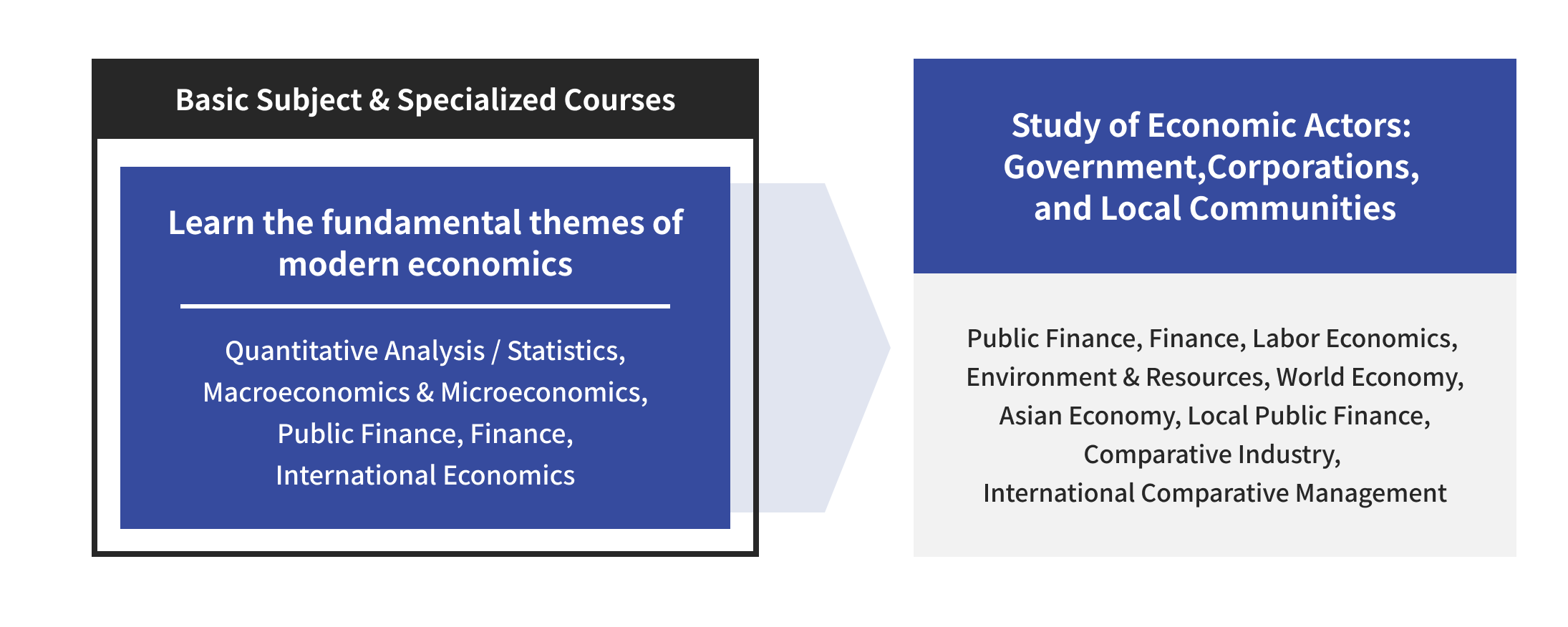
Through the acquisition of economic theory and knowledge from an international perspective and Practical learning research, we aim to cultivate highly skilled professionals who possess the ability to solve problems arising from globalization and the advanced information society, enabling them to thrive in the international community. The curriculum is based on fundamental subjects essential for understanding modern economics, such as mathematical statistics and macro and microeconomics, and systematically incorporates a wide range of applied and specialized subjects. Through their studies, each student cultivates their own interests and awareness of issues, and works on their doctoral dissertation based on their assigned research theme.
The Impact of Local Institutional Quality on Attracting Foreign Direct Investment in Provinces of Vietnam
The Effect of Service Quality on Customer Loyalty: The case of Uniqlo Viet Nam
Degree requirements
Division of Modern Economics in the Graduate Graduate School of Economics, which offers this program, allows students to obtain a degree by fulfilling the following requirements.
Enrolled for more than two years
The number of credits required for graduation is 30. Of these, at least 4 credits must be obtained from foundational subjects. In 1st year, there is a limit of 6 subjects (12 credits) per semester. In principle, students are required to take and complete the "Economics Seminar I and II" (2 credits each) taught by their academic advisor in 1st year, and "Economics Seminar III" (4 credits for the entire year) in 2nd year
To pass the defense of one's master's thesis.
Regarding the Ministry of Education, Culture, Sports, Science and Technology's "Special Program for Prioritizing the Placement of Government-Sponsored International Students" The aim is to encourage universities with excellent systems for accepting international students to build mechanisms for attracting outstanding international students by prioritizing the placement of students from overseas as government-sponsored international students at domestic universities.
Regarding the Ministry of Education, Culture, Sports, Science and Technology's "Government-Sponsored International Student Program" This system aims to contribute to the development of Japan and the world by promoting international exchange and goodwill, fostering human resources in other countries, promoting the internationalization of universities and other institutions in Japan, improving educational and research capabilities through this process, and ultimately contributing to the internationalization and revitalization of society as a whole.