Department of Education and Culture
  • Hachioji Campus
Faculty of Education Department of Education and Culture

Learn new forms of education in a practical manner and educate individuals who are involved in a wide range of educational activities.

The Department of Education and Culture trains students for a wide range of education-related positions, such as junior high and high school teachers, government officials, and education-related positions in business enterprises. Students learn through practical experience by interacting with children while proactively dealing with various issues that arise in the field of education, which changes with the times.

Department of Education and Culture Close-UP

Research presentation exchange meeting

Research presentation exchange meeting
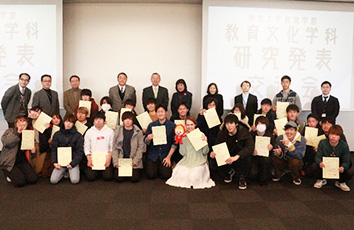
During the 1st year, students in the Department of Education and Culture independently set their research themes related to education and society through the Life Design Seminar, a compulsory first-year course, and conduct group research and exploration under the guidance of their assigned teachers. The results of this year-long research are presented in the form of research presentations.

Two Courses in the Department of Education and Culture

In 3rd year, Department of Education and Culture offers two course choices: the "Lifelong Learning Course" and the "Secondary Education Course," which allow students to study more in-depth and specialized subjects with an eye toward their future careers. This course choice is an opportunity to support students in proactively planning their own future prospects.

Two Courses in the Department of Education and Culture

カリキュラム

Department of Education and Culture coordinates learning with the aim of "nurturing talented individuals who can thrive in the fields of school education (secondary education) and lifelong learning." In 3rd year students are given the opportunity to choose from two courses: the "Secondary Education Course" and the "Lifelong Learning Course," which offer deeper study of their specializations and careers, helping them to proactively envision their future. Furthermore, through a series of courses related to contemporary educational issues linked to various professional qualifications, students are guaranteed diverse career options and are trained to develop individuals with a strong sense of awareness who can confront contemporary educational issues. Furthermore, through "Graduation Research (Special Lecture)," a small-group seminar unique to universities, students are given the opportunity to independently engage in academic and scientific research, primarily in education. This allows students to develop their own ability to see through the realities of society and education, and aims to develop them into individuals with the mindset of educators who will lead the way in the future.

Department of Education and Culture Curriculum Map

Syllabus

Department of Education and Culture Syllabus

Class Introduction

Theory and Teaching Methods of Moral Education
Recently, the importance of moral education has become a major topic of discussion. In this class, students will deepen their understanding of moral education by focusing on examples (social issues, for example) that could serve as material for lessons on morality while exploring the fundamental question of "what is morality?" One of the goals is to be able to write a teaching plan that will be conveyed to the reader.

Teaching methods for integrated learning time and special activities
The "Integrated Learning (Inquiry) Time" aims to cultivate students' ability to identify and solve problems independently by comprehensively utilizing what they have learned in various subjects while employing an inquiry-based perspective and way of thinking, and to deepen their understanding of their own way of life and being. Therefore, in this lesson, we will learn teaching methods for problem-solving activities through an inquiry-based learning process, utilizing "techniques for thinking" and "thinking tools." "Special Activities" consist of three parts: class (homeroom) activities, student council activities, and school events. These activities cultivate essential qualities and abilities for becoming a responsible member of a harmonious society, such as autonomy, interpersonal skills, and self-guidance. They also foster a supportive class and school atmosphere where students respect and acknowledge each other, which helps prevent bullying. Through practical learning activities such as group work and mock class meetings, we will learn teaching methods for developing students' social skills, autonomy, and self-guidance.

Career development and education
This course aims to deepen our understanding of the relationship between life and education by focusing on the aspect of human "development." People's career paths and the nature of education in schools change in response to the times. For example, if we look at employment after graduation, individual decision-making regarding career choices is underpinned by uniquely Japanese mechanisms and systems that support the transition from education to work. However, there is a need to re-examine whether these mechanisms and systems are truly appropriate. In addition to the transition from education to work, we will explore specific themes and topics related to career development, seeking to identify key issues.

Observation training
This course is designed for students in the Department of Education and Culture who wish to become junior high school or high school teachers. Of the 15 class sessions, six sessions are devoted to visiting junior high and high schools for class observations. The course will be offered in an intensive lecture format in September (during the university's summer break). The main contents of the class are (1) how to form a viewpoint to look at schools, classes, and students with a theme in mind, and (2) reflect on findings obtained through observation and how to theorize about them, in other words, learn the basics of the "exchange of practice and theory.

Grading Criteria

Grading Criteria

About our GPA System

The intent behind our implementation of a GPA (Grade Point Average) system is to (1) create a unified standard for the campus, (2) have it function as an impartial standard, and (3) have it function as an internationally accepted standard. Our GPA system involves the assessment learning achievements using an objective numerical value called GPA. Additionally, this system generally conforms with the grade assessment systems adopted by universities in the West, and can be used overseas as an index used to certify a student’s academic ability when studying abroad, when going on to graduate school overseas, when finding employment at a non-Japanese companies operating in Japan, and so on.

Display of Grades and Assessment Criteria

Classification Grading Criteria GPA Grading Criteria Details of Assessment Description of English
Pass S. 4.0 90 percent or higher Represents particularly excellent grades. Excellent
A 3.0 80 percent Represents excellent grades Good
B. 2.0 70 percent Represents grades recognized as adequate. Satisfactory
C. 1.0 60 percent Represents the minimum grade acceptable as a pass. Pass
Fail D. 0.0 Less than 60 percent This means that the student has not reached the minimum grade acceptable as a pass. It also includes the lack of class attendance, the fact that the exams for the class have not been taken, and so on. Failure
Not applicable G - - Indicates that course credit acquired another university or other institution during a study-abroad program or prior to a transfer to our university, has been certified as course credit for our university (courses where credit has been certified). Certification

GPA Calculation Method

GPA Calculation Method

To earn credits

  1. Register for classes. Use CampusSquare to register for classes online and have your classes properly confirmed. You will need to do this for both the first and second semesters.
  2. Students attend classes. There are 15 class in both the first and second semesters.
    Normally, 2-credit courses consist of attendance at each class (90 minutes) and preparation and review (about 2 hours each). In order to earn the credits, students must attend all classes (from the first to the 15th) as a matter of course, and also deepen their understanding through preparation and review.
  3. Depending on subjects, students are required to take exam or submit reports (accreditation methods vary from lecturers).
  4. Grades of S, A, B or C mean that students have passed the course and earned the credit. Grade of D means that students has failed the course and not earned any credit. If students receive a grade of D for a compulsory subject, they require to take it again the following year or later.
    Courses which students have already earned credit cannot be retaken.
  5. About Academic Grades
    • Academic grades are assessed based on final examinations at the end of the semester (written exams, oral exams, practical exams, or reports). However, depending on courses, mini tests, reports, attendance, and academic progress during class may be evaluated as regular points, or assessments may be carried out based on the regular points only.
    • Academic grades are issued on the transcript with only the evaluation. 
    • Courses which students have passed once cannot be erased or retaken.
    • Grades will be published on Campus Square every semester.
    • If you have questions about your grades after the results have been announced, such as if you took an exam (submitted a report) but did not receive a grade, please come to school at the beginning of the next semester (by the first week of classes in principle) and ask your teacher directly. If your teacher has retired and you are unable to make inquiries, please inform the Office of Academic Affairs Office.

Minimum number of credits required for graduation (for students entering in the 2026 academic year)

Subject classification Examples of compulsory and elective courses Required number of units
Co., Ltd.
Common
Teaching
Education
Department
eye
*4
education
Educational subjects
Humanities-related fields Optional compulsory 2 or more 8 or more 30※1
Social Sciences 2 or more
Natural Sciences 2 or more
Interdisciplinary fields Elective
First year
Educational subjects
Life Design Seminar I & II Compulsory 2
Career-related courses Optional compulsory 2
Information Education Subjects Optional compulsory 2
foreign language
Educational subjects
Modern English I / II / III / IV Compulsory 4
Specialized subjects *4 Compulsory 16 74※3
choice
Required *2
Educational science
Subjects
10
modern education
Problem-based subjects
4
Elective 44
Free Choice ・74 extra credits in specialized subjects
・30 credits in excess of General Education
・Open course credits
・Minor program credits
・Credits accredited at other universities
Elective 20
Total 124
  • *1 Students must complete the required number of credits for each General Education and must earn a total of 30 credits. In addition, any excess credits earned in General Education will be counted as elective credits.
  • *2 Excess credits earned in required elective subjects will be counted towards elective subject credits.
  • *3 Excess credits earned in specialized subjects will be counted as elective credits.
  • *4 Some credits for teaching and curatorial course subjects are included in the credits for specialized subjects or General Education.