Effective April 2026, Division of Economics has been renamed the "Division of Modern Economics."
Highly specialized professionals are fostered with systematic economic knowledge and flexible thinking ability
English program available
In the Master's program, students will solidify their foundational knowledge of economics and statistics through introductory courses, while also being exposed to a wide range of specialized subjects before proceeding to the production of a doctoral dissertation or a specific research project. We have significantly increased the number of courses taught in English, making it possible to complete all required credits for graduation through English-taught courses. We hope that motivated students will actively take advantage of this opportunity.
Strengthen the foundation and emphasize data analysis.
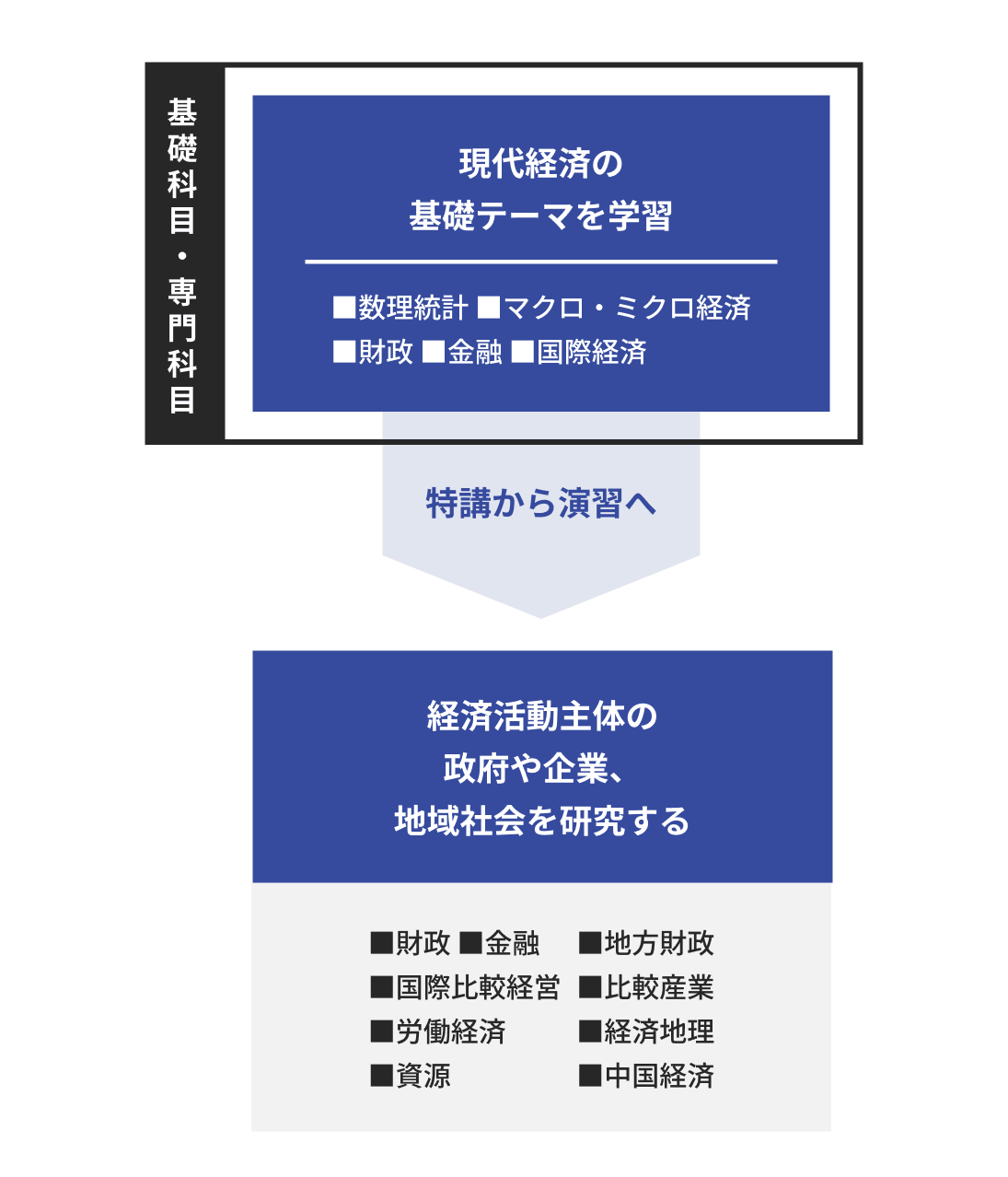
The specialized subjects include fundamental topics essential for understanding the modern economy, such as mathematical statistics, macroeconomics and microeconomics, public finance, monetary policy, and international economics, which can be systematically studied through special lectures. Current applied economics and policy research demands data-driven, evidence-based arguments, and the need for research emphasizing data analysis is increasing. This curriculum aims to provide the knowledge required in this era.
Working on cutting-edge themes in a wide range of specialized fields.
To study governments and corporations, which are the main actors in economic activity, and the regions where economic activity takes place, students tackle cutting-edge themes in fields such as public finance, monetary policy, local government finance, international comparative management, and comparative industries, including comparative management of Japanese, American, and European companies, comparative industrial development in Japan and Asia, and changes in Japanese employment practices. International students often study similar cases in Japan and other Asian countries before choosing their own country's case as their research topic. Master's theses can be submitted in English. In recent years, outstanding master's theses have been reviewed and presented at academic conferences in their respective fields.
Teikyo Asia Graduate Program for Advanced Human Resource Development
This is a special program established within this department for international students. It aims to cultivate highly skilled individuals who will contribute to Asia's economic development by accepting promising students from rapidly developing Asia and providing education and research guidance based on the university's Practical learning philosophy. It also aims to foster individuals who will deepen their understanding of Japan by studying alongside Japanese students, thereby forming the foundation for strengthening relations between Japan and Asia. This program is a selected program under the Ministry of Education, Culture, Sports, Science and Technology's "Special Program for Prioritizing the Placement of Government-Sponsored International Students in FY2025." The priority placement period is three years, from FY2026 to FY2028, with a quota of five students allocated each year.
Grades will be announced each semester on Campus Square (at the end of the academic year for students taking only year-round courses).
Grading Criteria
Score
Veredict
S.
100-90 points
Pass
A
89-80 points
B.
79-70 points
C.
69-60 points
P
Pass (Thesis Review)
D.
59-0 points
Fail
* D: Failing will not be recorded on the transcript.
Course and Completion Requirements
Master's Program
[Economic Theory and Applied course in Economics] About course enrollment
The number of credits required to complete is 30 credits.
In principle, students must take and complete "Economics Seminar I & II" (2 credits each) offered by their supervisor in 1st year, and "Economics Seminar III" (4 credits throughout the year) in 2nd year.
Students must decide whether to submit a master's thesis or a specific research project in consultation with their supervisor by the time they submit their dissertation title declaration in 2nd year at the latest.
Duplicate courses of the same subject are not allowed.
1st year, students are limited to six subjects and 12 credits per semester.
About Completion
Compleation of the program is attained by satisfying the required number of credits and passing the examination of the master's thesis or specific subject research.
Doctoral Program
About course enrollment
You need 12 credits to complete.
There is no distinction between compulsory and optional, but as a general rule, please take the courses of your academic advisor for three consecutive years.
If required, you can take a master's degree course, but you will not be accredited for credits.
About Completion
Completion of the program is attained by satisfying the required number of credits and passing the doctoral dissetation examination.
Even if the required number of credits is fulfilled, failure to submit or fail to pass the doctoral dissertation will result in dismissal from the program at the end of the term.