
Topics
- Education and Research
April 22, 2026
- Press Releases
An international research group led by Associate Professor Yamada has discovered a gene expression mechanism that increases drug resistance in dermatophytes (athlete's foot).
On March 31, 2026 (Tuesday), a joint Japanese-Swiss research team led by Associate Professor Tsuyoshi Yamada of Teikyo University Institute of Medical Mycology revealed the full extent of a large-scale tandem duplication of genes encoding the target molecules of azoles that are resistant to azole antifungal drugs (azoles), which are representative treatments for fungal infections.
The results of this research were published in *Antimicrobial Agents and Chemotherapy*, a journal published by the American Society for Microbiology on March 31, 2026 (Tuesday).
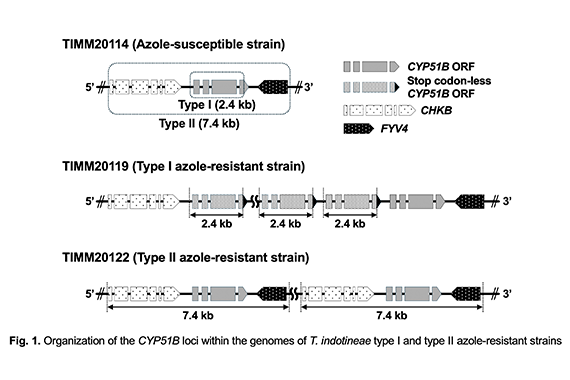
Previously, an international collaborative research group led by Associate Associate Professor Yamada and Professor Emeritus Michel Monod of the Faculty of Biology and School of Medicine and the University Hospital of Lausanne, Switzerland, revealed that numerous genomic DNA regions containing the CYP51B gene, which encodes the CYP51 protein (the target molecule of azoles), overlap in tandem, leading to overproduction of the CYP51 protein and resulting in azole resistance. They also showed that azole-resistant bacteria can be classified into Type I and Type II based on the length of the overlapping genomic DNA fragments. However, at that time, the scale of the genomic DNA fragment overlap was so large that they could not elucidate the structure of the entire region.
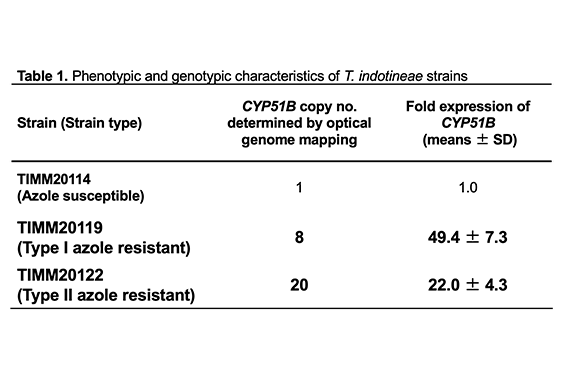
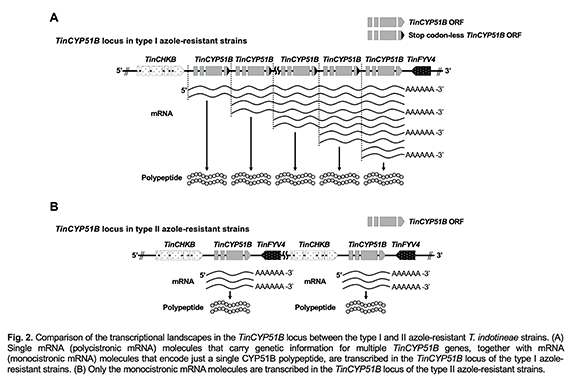
In this study, we attempted to identify the number of duplicates (copy numbers) of the CYP51B gene in the genomes of type I and type II azole-resistant bacteria by utilizing optical genome mapping (OGM) technology, which involves fluorescently labeling high molecular weight genomic DNA and detecting structural variations in the genome based on the optically read patterns. The results revealed tandem duplication of the gene eight times in type I resistant bacteria (TIMM20119) and 20 times in type II resistant bacteria (TIMM20122). Furthermore, in type I resistant bacteria, a single promoter region was found to have duplicated. We have elucidated that polycistronic transcription occurs, in which multiple CYP51B genes (open reading frames) are successively transcribed into a single mRNA molecule.
Polycistronic transcription is a phenomenon mainly observed in gene expression in prokaryotes, while eukaryotes typically undergo monocistronic transcription, where one gene is transcribed into a single mRNA molecule. However, polycistronic transcription, distinct from normal gene expression, has been observed in the cells of the eukaryotic fungus *Trichophyton*, and this has been identified as a contributing factor to drug resistance in pathogenic fungi. In recent years, with the advancement of NGS technology, examples of polycistronic transcription in eukaryotes have gradually been reported. Further advancements in genome structure analysis of *Trichophyton* are expected to uncover interesting new biological phenomena.
The press release is available here.
The published paper can be found here.
Click here for information about the Medical Mycology Research Institute.
Click here for more information about Associate Professor Yamada.