Effective April 2026, Division of Interdisciplinary Cultural Studies has been renamed Division of International Cultures.
World cultures and societies We will explore this from multiple perspectives.
Overview of Division of International Cultures
Improve your English proficiency The Master's program provides a two-year integrated education program as foundational training for English communication skills on an international stage. In 1st year, "Foreign Language Practice Seminar I & II" focuses on refining expressive English skills such as writing papers and giving presentations, while paying attention to the differences in thinking between Japanese and English. In 2nd year, "Foreign Language Practice Seminar III & IV" focuses on studying "Second Language Acquisition Research" in relation to one's own second language acquisition experience, deepening understanding and aiming to improve practical skills such as logically presenting in one's native language or second language and writing reports.
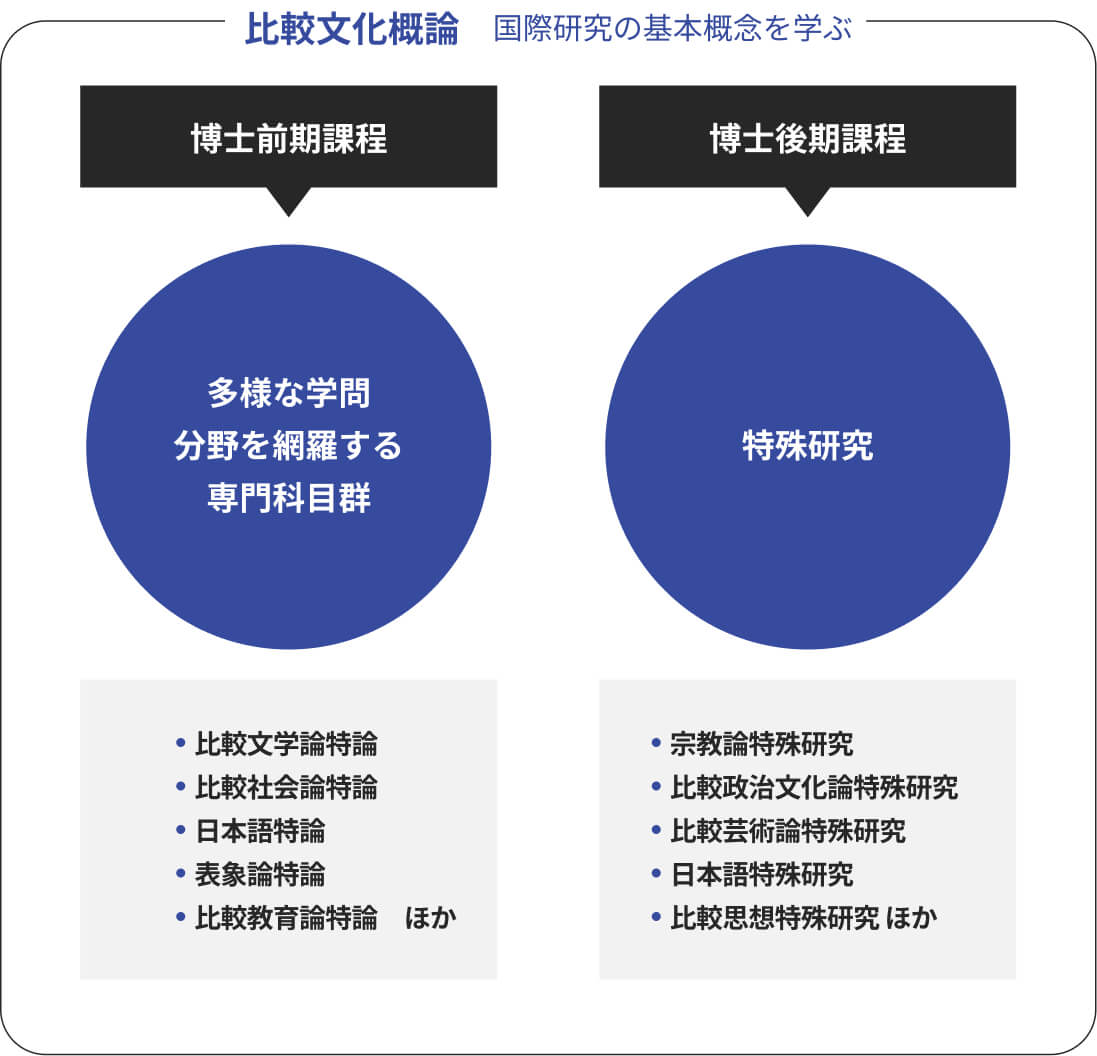
Diverse subject arrangements In Division of International Cultures, students cultivate international knowledge by placing their respective fields of specialization within a "global" context and broadening their perspectives beyond a single academic domain. The diverse range of specialized courses, encompassing culture, religion, literature, political culture, art, society, thought, and representation, encourages free thinking that transcends national and cultural boundaries. By broadly studying these courses, students aim to develop new interpretations of global societies and cultures from an international perspective and an unbiased viewpoint.
Placing Japan within a global context For those of us who study and live in Japan, understanding "Japan" is a crucial issue. In Division of International Cultures, we cultivate the ability to place Japan within a global context and communicate Japan to the world from a new perspective. The characteristics and "uniqueness" of the Japanese language, Japanese literature and culture, Japanese education, Japanese history, Japanese customs and traditions, Japanese thought, Japanese politics, and Japanese religion become clear when compared to other countries and cultural spheres around the world. In the doctoral program, we delve deeper into each theme based on the fundamental knowledge acquired in the master's program.
Grades will be announced each semester on Campus Square (at the end of the academic year for students taking only year-round courses).
Grading Criteria
Score
Veredict
S.
100-90 points
Pass
A
89-80 points
B.
79-70 points
C.
69-60 points
P
Pass (Thesis Review)
D.
59-0 points
Fail
* D: Failing will not be recorded on the transcript.
Course and Completion Requirements
Master's Program
About course enrollment
The number of credits required to complete is 30 credits. (Required subjects ... 10 credits, elective subjects ... 20 credits)
Each subject has 2 credits.
Methodology Exercises: This is a course to deepen the knowledge of the fields related to students' thesis and to acquire the methodology necessary for writing a thesis. Academic advisor will be decided in the 1st year, and students will take methodological exercises offered by an academic advisor in the 2nd year.
The maximum number of courses that can be registered in 1st year is 6 courses totaling 12 credits in both the first and second semesters.
About Completion
Completion of the program is attained by satisfying the required number of credits and passing the examination of a dissertation.
Doctoral Program
About course enrollment
You need 12 credits to complete.
Each subject has 4 credits.
About Completion
When you take the neseccary credits and pass the dissertation examination, you will complete.
Even if the required number of credits is fulfilled, failure to submit or fail to pass the doctoral dissertation will result in dismissal from the program at the end of the term.
(3rd year) If you are completing your doctoral program in March, please submit your dissertation and other necessary documents to the Office of Academic Affairs Graduate School Office, Academic Affairs Division by early November.