
Topics
- International Exchange
August 28, 2026
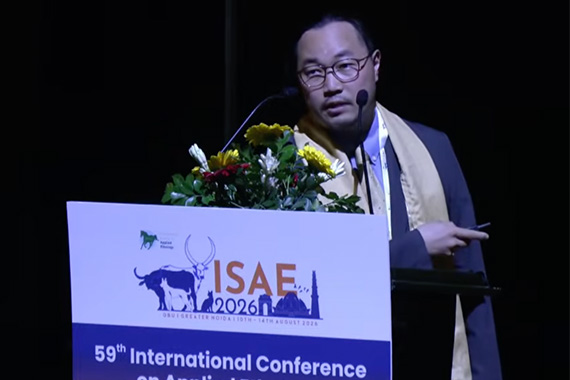
Senior Assistant Professor Miyashita of the Institute for Medical Mycology delivered an invited keynote speech, the "Wood Goujch Memorial Lecture," at ISAE 2026.
On August 11, 2026 (Tuesday), at the 59th International Society for Applied Ethology (ISAE 2026) held at the Gautam Buddha University Convention Center in Greater Noida, India, Dr. Atsushi Miyashita, Senior Assistant Professor at the Institute of Medical Mycology, Teikyo University, delivered an invited keynote lecture, the Wood Gush Memorial Lecture.
The Wood-Gush Memorial Lecture is an invited lecture at the ISAE Annual International Conference, established in memory of Professor David Wood-Gush (1922–1992), who made significant contributions to the development of applied animal behavior and animal welfare science. Following Professor 's death, a memorial fund was established in 1993, and the lecture has been held annually since its inaugural presentation in 1994.
This time, Senior Assistant Professor Miyashita was invited to this prestigious lecture series, where he spoke about silkworm infection models and drug discovery research utilizing AI and automated observation.
In the lecture, I explained the importance of selecting the optimal biological model for the research objective, rather than simply choosing between "to conduct or not to conduct" animal experiments in pharmaceutical research. While there is value in using live organisms when evaluating phenomena where infection, immunity, drug efficacy, toxicity, and pharmacokinetics are interconnected, I also showed the possibility of utilizing models that are easier to handle and have a lower ethical burden, depending on the scientific objective.
Silkworms are suitable for in vivo evaluation using a relatively large number of individuals, as they allow for quantitative testing of infections, drug administration, and body fluids. Senior Assistant Professor Miyashita introduced the exploratory research for antimicrobial and antifungal drugs using silkworm infection models, citing examples of previous drug discovery research using silkworms, such as the discovery of the novel antimicrobial agent lysocin E and the novel antifungal agent ASP2397 by Professor Kazuhisa Sekimizu and others at the Faculty of Faculty of Pharmaceutical Sciences of this university.
Furthermore, Senior Assistant Professor Miyashita explained drug discovery research targeting mucormycosis, one of the invasive fungal infections, which he is currently promoting, as well as methods for quantitatively evaluating survival status, activity, changes in posture, and recovery processes using AI-based image analysis. These technologies were introduced not merely as automation of observation work, but as new research methods that also address the challenges of applied animal behavior, such as how to observe and interpret the state of an individual animal.
Through this presentation, we communicated to international researchers that infection models using silkworms can serve as a useful foundation for supporting infectious disease research and drug discovery research while balancing consideration for animal welfare and scientific validity. Our university will continue to promote infectious disease research, drug discovery research, and the advancement of experimental systems using AI, utilizing silkworm resources.
Click here for information about the Medical Mycology Research Institute.
Click here for information about Senior Assistant Professor Miyashita.