Topics
- Education and Research
October 8, 2026
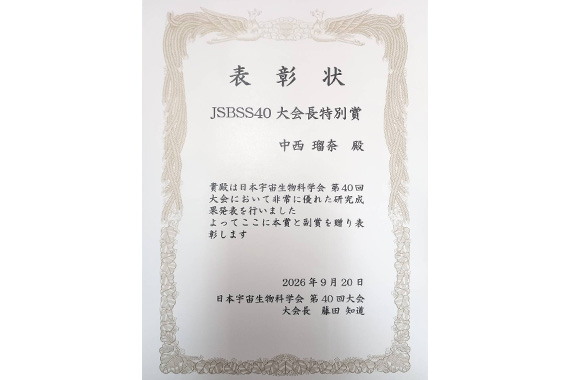
A student from Faculty of Science and Engineering received the President's Special Award at the 40th Annual Meeting of the Japan Society for Space and Biological Sciences (Utsunomiya Campus
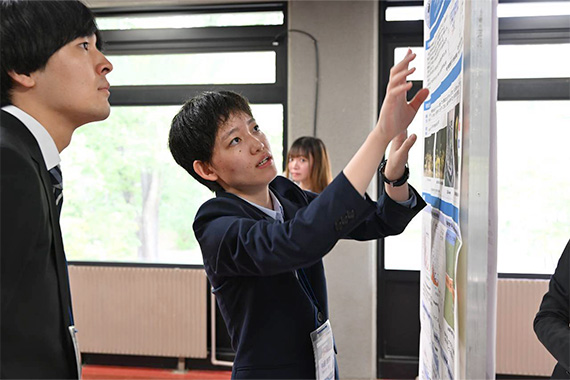
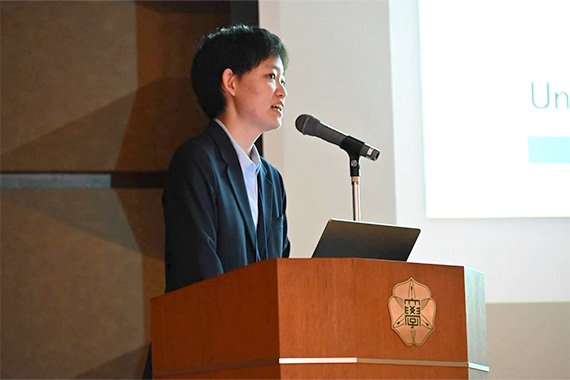
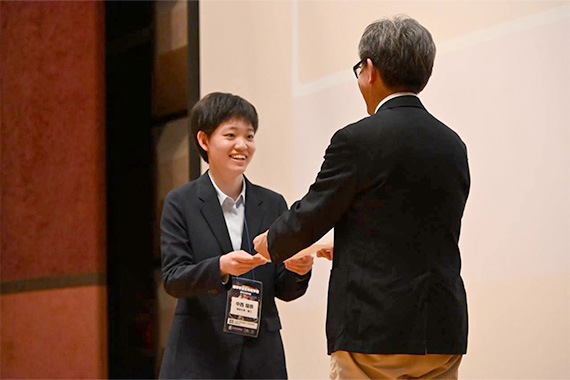
On September 20, 2026 (Sunday), at the 40th Annual Meeting of the Japanese Society for Space Biological Sciences held at Hokkaido University (Sapporo, Hokkaido), Runa Nakanishi (3rd year student, Faculty of Science and Engineering) presented her research findings on "Follow-up report on the evaluation of the effects of microgravity on fruiting body formation in cellular slime molds" and received the Conference President's Special Award.
Cellular slime molds are considered important research materials as model organisms for multicellular organisms, despite being microorganisms, because they share genes with higher animals, their entire genome has been sequenced, and molecular biological techniques are easily applicable. The Space Systems Research Group and the Department of Biology, led by Nakanishi, have been conducting research using cellular slime molds to clarify the effects of microgravity in the space environment on microorganisms. In this conference presentation, they examined the reproducibility of previous experimental results and conducted experiments under a simulated microgravity environment using a clinostat. As a result, they confirmed phenomena such as a decrease in the number of fruiting bodies (structures containing spores) and heterogeneity in the size of spore clusters. On Earth, a certain amount of spore clusters is necessary for reproduction, but under microgravity, that number decreases, suggesting that the organisms may be adopting a survival strategy of forming more spores. This research is being conducted as part of the activities of the Space Systems Research Group and the Department of Biology, and cellular slime molds are currently on board TeikyoSat-4, the university's own artificial satellite currently in operation. It is expected that the analysis results from future satellite experiments will further advance our understanding of life phenomena in the space environment.
Click here for information about Faculty of Science and Engineering
Click here for information about the Japanese Society for Space and Biological Sciences.