
Topics
- Education and Research
July 28, 2026
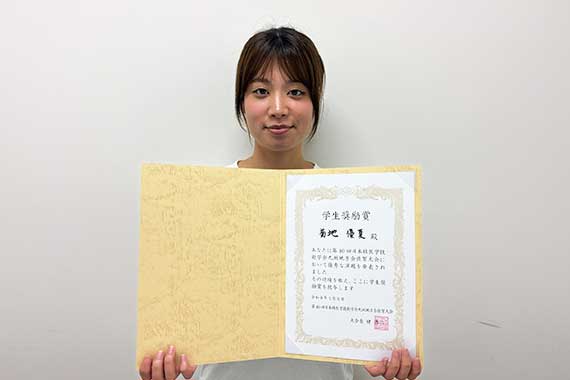
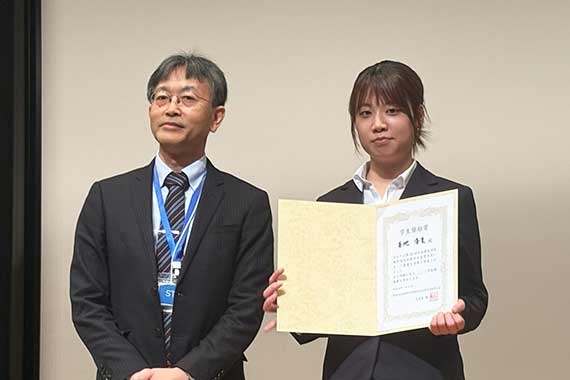
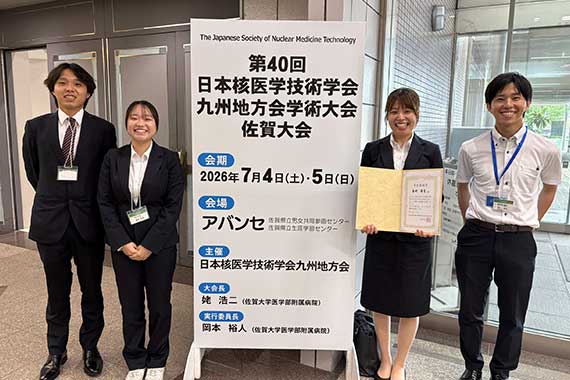
A student Faculty of Fukuoka Medical Technology received the Student Encouragement Award at the 40th Annual Meeting of the Kyushu Regional Chapter of the Japanese Society of Nuclear Medicine Technology (Fukuoka Campus
On July 4th (Sat) and 5th (Sun), 2026, at the 40th Annual Meeting of the Kyushu Regional Chapter of the Japanese Society of Nuclear Medicine Technology, held at the Saga Prefectural Gender Equality Center and the Saga Prefectural Lifelong Learning Center (Saga City, Saga Prefecture), Yuka Kikuchi, a student at our university (4th year Faculty of Fukuoka Medical Technology), received the Student Encouragement Award.
Ms. Kikuchi is conducting research under the guidance of Yuya Sekikawa, Senior Assistant Professor in the Department of Department of Radiological Technology Faculty of Fukuoka Medical Technology, and presented her research at the conference with the title "Examination of the reproducibility of the region of interest using deep learning in 99m Tc-PYP planar images for ATTR-type cardiac amyloidosis."
Ms. Kikuchi's research developed and validated a technology that uses AI to automatically estimate the cardiac region of interest (ROI) in cases suspected of having ATTR-type cardiac amyloidosis and undergoing 99m Tc-PYP myocardial scintigraphy. 99m Tc-PYP myocardial scintigraphy diagnoses patients by evaluating the accumulation of radiopharmaceuticals in the heart. However, accurately positioning the heart is highly dependent on the examiner's experience, and determining the heart's location is particularly difficult in cases with low accumulation. In this study, an AI model was constructed using cardiac ROIs set by radiological technologist in the nuclear School of Medicine as training data. The study compared cases where students provided AI assistance in setting ROIs with and without it. The results showed that when AI assistance was provided, the DICE coefficient, which measures the degree of agreement with the ROI set by radiological technologist, significantly improved, confirming increased reproducibility of ROI setting. In particular, the study demonstrated the potential for more appropriate ROI setting in cases with low cardiac accumulation by visually presenting candidate regions using AI. This research is expected to reduce inter-examiner variability in 99m Tc-PYP myocardial scintigraphy, leading to more objective and reproducible image analysis, which is why it has been awarded this prize. We look forward to Ms. Kikuchi's future contributions.